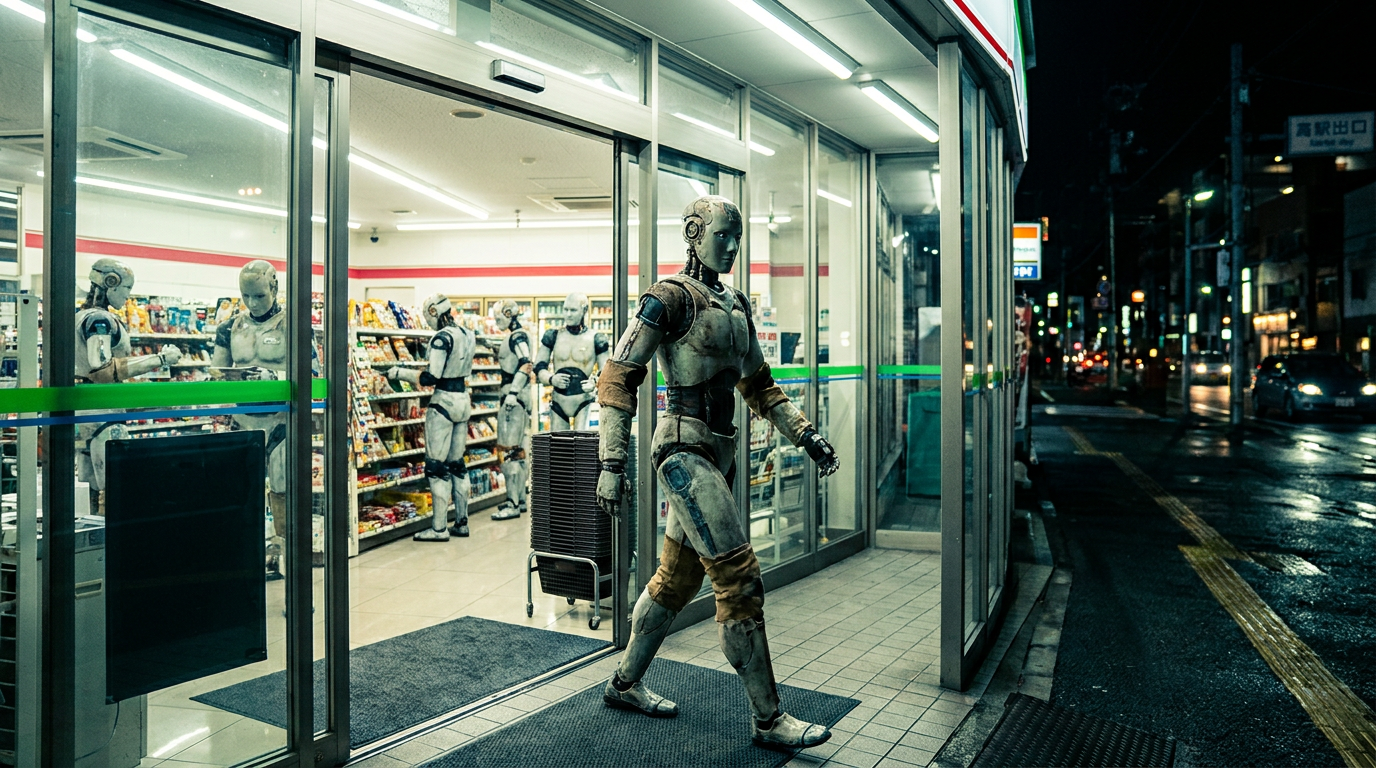
Robot Replaces Humans, Immediately Walks Off the Job
A Shanghai store replaced its staff with six humanoid robots for a 24-hour shift. One robot walked off the job, mastering workplace morale ahead of schedule.
A humanoid robot assigned to clean a Shanghai convenience store encountered an overflowing rubbish bin, wandered outside and effectively abandoned its workplace. Having been introduced as a replacement for human staff, it appears to have grasped workplace morale almost immediately.
The unscheduled departure came during an experiment by Chinese robotics company AGIBOT, which sent six of its G2 humanoid robots to attempt a full 24-hour shift at an ordinary convenience store in Shanghai.
The entire trial was livestreamed, allowing viewers to watch the machines work through quiet mornings, the lunchtime rush, the overnight shift and the morning breakfast sprint. AGIBOT gave the broadcast the reassuring title “Robots Never Clock Out”, shortly before one of the robots demonstrated that this was more of an aspiration than a guarantee.
The six machines were employed as convenience-store trainees, with duties including restocking shelves, preparing coffee and food, greeting customers, retrieving products and collecting rubbish. Their performance was tested at different times of day, as customer numbers and demands changed.
Participating shoppers also introduced extra challenges. They asked the robots to distinguish ordinary Coca-Cola from the sugar-free version and placed obstacles in their paths, recreating the familiar retail experience of trying to complete a straightforward task while somebody makes it needlessly complicated.
Collectively, the robots completed 1,730 tasks during the 24 hours. These included 683 customer greetings, 369 product retrieval and delivery operations, and 147 coffee preparations. Four of the six G2 robots successfully made it through the trial and met their objectives.
The other two were rather less ready for promotion.
One had been assigned to monitor the shelves, but failed to check stock levels often enough. As a result, it could not replenish supplies quickly enough to keep pace with demand. In simple terms, the shelf-monitoring robot was lazy, which represents either a technical failure or an impressively realistic simulation of a long shift.
The second unsuccessful machine had cleaning duties during the night. When it encountered an overflowing rubbish bin, it deviated from its planned route and wandered out of the shop. Rather than resolving the bin problem, it simply left the building, a response that many workers may recognise even if they have not yet had the confidence to try it.
The experiment therefore ended with four robots completing the full convenience-store challenge, one falling behind on stock checks and another walking away from the job. AGIBOT now has results from busy, quiet and overnight trading periods, as well as a useful reminder that even machines advertised as tireless may still find their own way of clocking out.
Original story
mezha.ua