Robot Beats Sprint Record, Loses to Wall
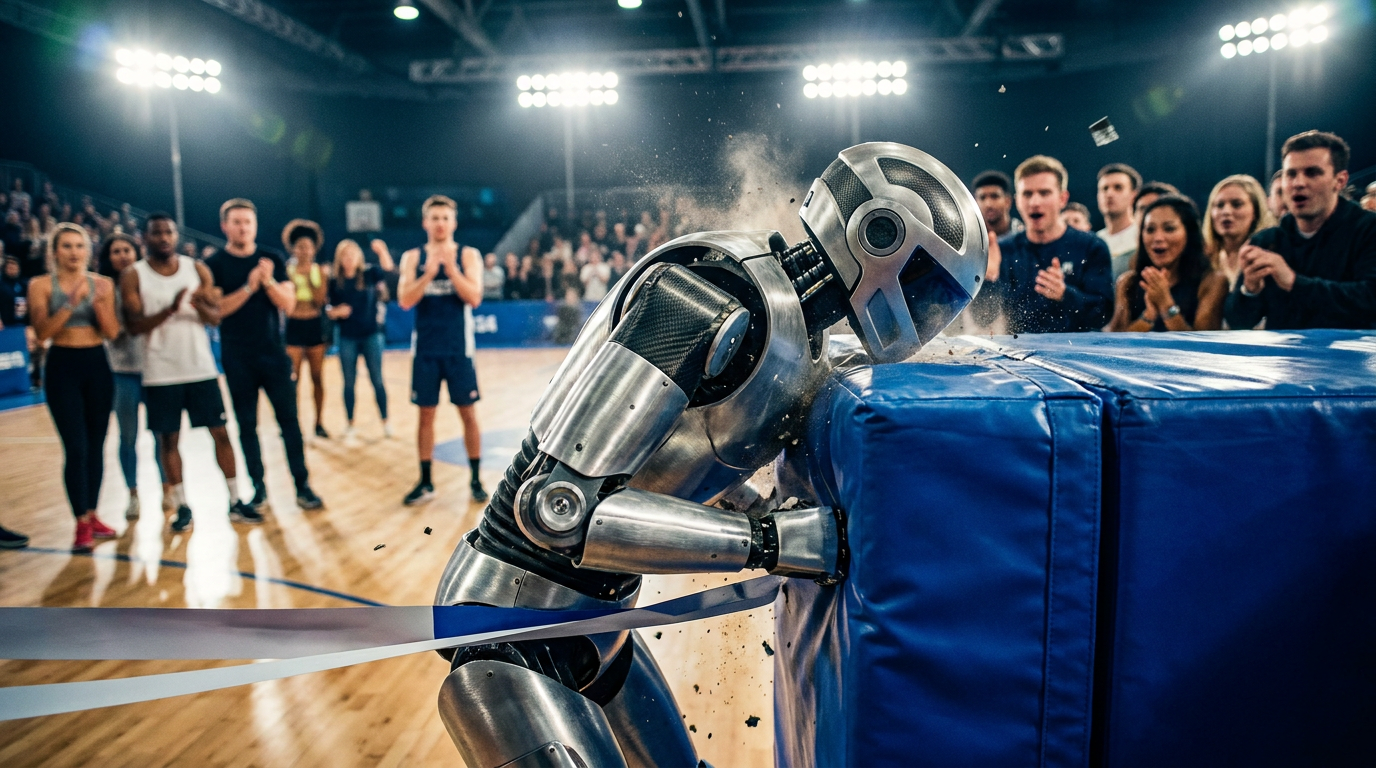
A humanoid robot ran 100 metres in 8.64 seconds at Beijing’s World Humanoid Robot Games. It crossed the line faster than Usain Bolt’s record, then slammed into a padded barrier. Apparently stopping remains a premium feature.
A humanoid robot ran 100 metres faster than Usain Bolt’s world record, crossed the finish line and immediately lost its next contest to a padded blue wall.
The Chinese-built machine completed the sprint in 8.64 seconds on the final day of the World Humanoid Robot Games in Beijing, nearly a full second quicker than Bolt’s record. Unfortunately, sprinting and stopping appear to be separate branches of robotics.
The barrier beyond the finish line was not an oversight. Organisers put it there because humanoid robots tend to cross at full speed, strike the padding and crumple to the ground. Sparks sometimes fly, staff occasionally rush in with fire extinguishers, and damaged competitors are often carried away on stretchers. One robot received the stretcher treatment after taking part in the 1,500-metre race on Aug. 23.
The record-setting machine was Tiangong Ultra. It broke the sprint record three times during the five days of competition, an impressive rate of progress for something whose braking system still consists largely of nearby upholstery.
The second World Humanoid Robot Games took place from Aug. 22 to 26 at Beijing’s National Speed Skating Oval, which was built for the 2022 Winter Olympics. Organisers said more than 2,000 robots representing over 600 teams from 16 countries competed.
Events included boxing, soccer, tug-of-war and break dancing, alongside practical challenges such as industrial assembly and folding laundry. There were also robot cheerleaders equipped with pom-poms, presumably on hand to offer encouragement while keeping a sensible distance from the sprint track.
The standing high jump showed how quickly the technology is improving. Robots had to leap from a stationary position, with this year’s winner reaching 3.4 metres, higher than most ceilings. At the previous games, the best result by a humanoid was 0.95 metres.
Tech analyst Carmi Levy said the crashes and malfunctions were evidence of development rather than technological defeat.
“Failure is part of the equation when developing advanced technologies like robotics and AI. You iterate, it fails, you learn why it fails, you improve the technology, and you go from there,” Levy said. “SpaceX blows up its rockets all the time, and they get better with each successive launch. These robots are following exactly the same game plan.”
The next step, then, is more testing, more improvement and presumably fewer stretchers. For now, Tiangong Ultra has demonstrated that a robot can outrun the fastest human in history, provided nobody asks it to slow down afterwards.
Original story
bnnbloomberg.ca