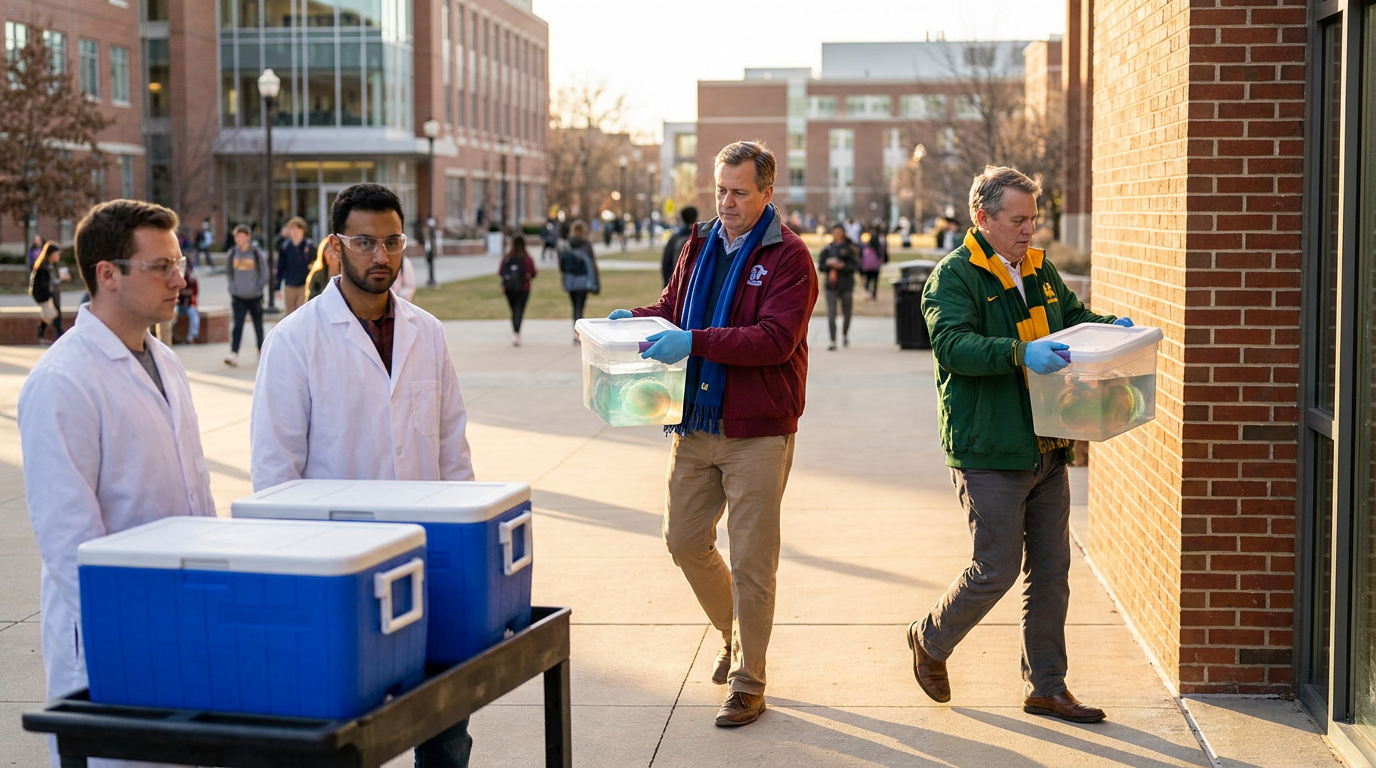
Michigan Rivals Launch a Literal Pissing Contest
Michigan and Michigan State have teamed up for a “Piss Off” competition. They’re collecting urine for fertilizer research, finally giving academic rivalry somewhere productive to go.
Michigan and Michigan State are settling their rivalry with two yurts, a nearly 300-gallon tote and an invitation for football fans to pick a side before having a wee.
The universities have teamed up for the first “Piss Off” competition, in which supporters attending their rivalry game during the weekend after November 5, 2026, can donate urine in the name of either MSU or the University of Michigan. At last, college allegiance can be measured using something other than touchdowns and shouting.
Professors from both institutions will set up the yurts on the golf course near the tailgating area. Attendees can choose which university receives their contribution, with the winner determined by which side collects more pee. It is academic competition in its most literal stream.
There is, however, serious research behind the bladder-based bragging rights. The urine will be treated so its nutrients can be extracted and used as fertiliser for non-food agricultural products.
“What we are trying to do is to look at the potential treatment of urine and extraction of the nutrients for application to non-food agricultural products,” said Stephen Gasteyer, a professor at Michigan State.
Gasteyer explained that human waste contains resources useful to other living things, though it cannot simply be applied directly. “Our waste is food for other biological organisms, writ simply. And so while we recognize that we can't do that directly, Dr. Love and colleagues have come up with a treatment technology that can extract the nitrogen, phosphorus, potassium — all come out of our urine,” he said.
Dr. Love is Nancy Love, a University of Michigan professor who studies civil and environmental engineering. She hopes the contest will collect hundreds of gallons, although even school spirit must eventually yield to storage capacity.
“It'll be about just under 300 gallons—we have an IBC tote that takes about that much. So that'll be our limit,” Love said.
According to Love, fertiliser derived from human urine could offset between 20% and 25% of the nitrogen needed to grow grasses, flowers and other plants people do not eat. It may also be possible to use it for food crops, but that remains the subject of future studies.
Researchers will need to establish which treatment processes can ensure that bacteria, pathogens and medicines do not end up in the finished fertiliser. There is also the delicate matter of persuading the public that crops and recycled urine can comfortably occupy the same sentence.
“We know from research that that's a hard leap for people to get to. So that's why we've been focusing on flowers and grass,” Love said.
Both Love and Gasteyer said the football weekend should provide enough raw material for several months of study. Once the tote is full and the rivalry has run dry, the universities will have a substantial supply for research—and one fan base will have earned the right to say it gave more.
Original story
cbsnews.com